
Our Commitment
Coffee That’s Good For People & Planet
At Epuria, sustainability isn’t the foundation on which every partnership and every shipment of Indonesian green coffee beans to Australia is built.
- Farmer Wellbeing
- Environmental Stewardship
- Supply chain Transparency
- Community Investment
Why
Sustainability
Is Non-Negotiable
“Great coffee cannot exist without healthy land, thriving farming communities, and a supply chain built on honesty.”
2,100m
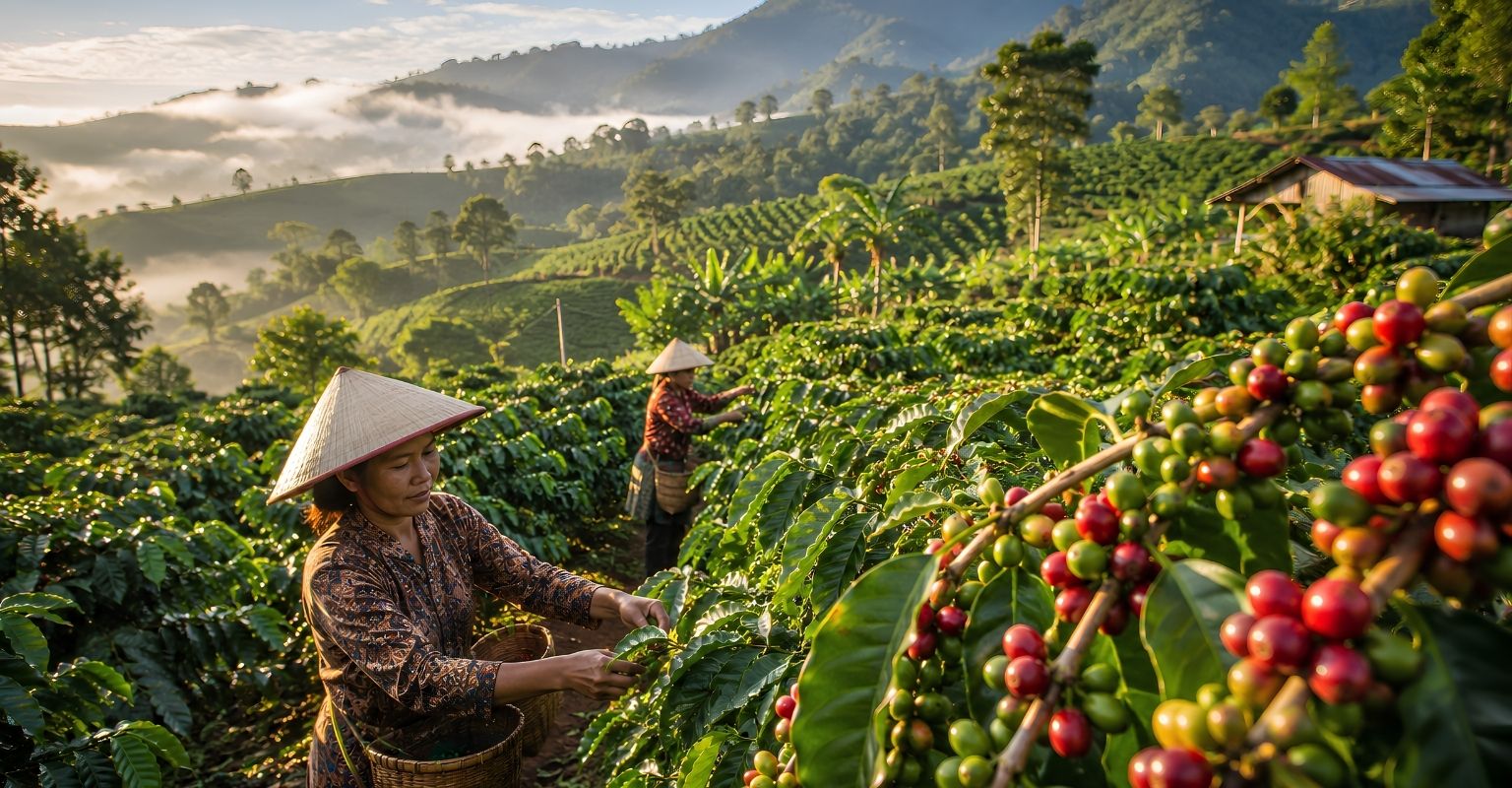
Indonesia is one of the world’s great coffee nations — home to more than 1.5 million smallholder farming families whose work sustains not only the global coffee industry, but entire rural communities across Sumatra, Java, Sulawesi, Bali, and Flores. Over 90 percent of Indonesia’s coffee is grown by these small-scale producers, each farming plots that are often no larger than one or two hectares, passed down through generations.
The decisions that importers make — who they partner with, what they pay, what standards they demand — have real consequences for those families and for the landscapes they steward. At Epuria, we believe that importing Indonesian green coffee beans into Australia carries a genuine responsibility: to the growers at origin, to the roasters we supply, and to the end consumers who want to know the story behind their morning cup.
Our sustainability commitment rests on three pillars — People, Planet, and Transparency. These are not aspirational targets or marketing language. They are the operating principles that shape every commercial relationship and every lot we select.
Coffee production worldwide is also under increasing pressure from climate change — shifting rainfall patterns, rising temperatures, and increasingly unpredictable growing seasons are already affecting yields across the Indonesian archipelago. Supporting farming practices that build long-term resilience is not just ethically correct; it is commercially essential for the future of the specialty coffee supply chains that Australian roasters depend upon.
People, Planet, Transparency
Every decision at Epuria is measured against these three commitments. Together, they define what ethical green coffee importing looks like in practice.
01
🌿
People
We pay above-market prices for our green coffee lots — always. Fair, transparent pricing is the most direct lever an importer has for improving farmer livelihoods. We build long-term relationships with the farming co-operatives and estate managers we source from, rather than transactional, spot-market arrangements. Long-term partnerships enable farmers to invest in quality improvements, processing infrastructure, and the next generation of growers.
We also prioritise sourcing from cooperatives that actively support women producers and that invest community contributions — including through traditional Indonesian practices like zakat, the custom of charitable giving that sees producers contribute a portion of income back into their communities in the form of seedlings, fertiliser, and agricultural support.
02
🌍
Planet
The Indonesian coffee landscape is intimately connected to some of the most biodiverse ecosystems on Earth. Unsustainable farming practices — including deforestation, excessive pesticide use, and over-irrigation — threaten not only those ecosystems but the long-term viability of coffee production itself.
We actively seek out lots grown under shade-canopy systems, using agroforestry approaches that preserve biodiversity and natural carbon storage. We give sourcing preference to farms and cooperatives that employ integrated pest management, practice crop rotation, and reduce reliance on synthetic inputs. On the logistics side, we continuously work to optimise our shipping routes and packaging to minimise our carbon footprint on every container we import into Australia.
03
🔍
Transparency
We believe the Australian roasters and coffee businesses we supply deserve complete visibility into the origins of every lot they purchase from us. That means full lot documentation — island, region, cooperative or estate, processing method, harvest season, and cupping scores — provided with every order.
It also means honest communication: when lots are limited in availability, when harvests face challenges due to climate pressures, or when pricing must reflect the true cost of sustainable production. Transparency is not just a value proposition for consumers. It is the foundation of a supply chain built to last.
The Smallholder Farmers Behind Every Green Bean
Understanding the human scale of Indonesian coffee production is essential to understanding why our sourcing approach matters. The Indonesian coffee industry is not dominated by vast corporate estates. It is built on the labour, knowledge, and land-stewardship of more than 1.5 million smallholder farming families — the overwhelming majority operating on plots of one to two hectares.
These farmers face real challenges: volatile global commodity prices, increasing climate uncertainty, limited access to agricultural training, and the risk of exploitation through opaque supply chains. Direct trade and transparent pricing are not luxuries in this context — they are the structural conditions that allow smallholder coffee farming to remain economically viable for the next generation.
Many Indonesian farming cooperatives are also embracing organic practices and seeking international certifications to access premium export markets. This transition requires investment, training, and stable buyer relationships — all things that Epuria’s partnership model is specifically designed to support.
90%
1.5M+
6+
400 yrs
What We Do to Protect the Land Behind the Bean
Shade-Grown & Agroforestry Preference
We actively prioritise lots from farms that grow coffee under forest shade canopy or in agroforestry systems — practices that preserve biodiversity, protect soil health, and create natural habitat for wildlife. Shade-grown coffee systems also produce more complex, slower-ripening beans, typically resulting in higher cup quality.
Reduced Chemical Input Sourcing
We give sourcing preference to farms and cooperatives engaged in integrated pest management (IPM), crop diversification, and the responsible reduction of synthetic pesticide and fertiliser use. These approaches reduce environmental harm, protect farmer health, and improve the long-term resilience of the land.
Responsible Packaging & Logistics
Green coffee beans imported by Epuria are shipped in high-quality GrainPro or jute sack packaging to preserve bean freshness without unnecessary plastic. We consolidate shipments to reduce freight emissions, and we are actively working toward carbon-neutral shipping for all containers arriving in Australia.
Climate Resilience Support
Climate change is already altering growing conditions across Indonesian coffee regions, threatening yields and quality. We support our farming partners in adopting climate-smart agricultural practices — including crop diversification, improved soil management, and access to climate-resilient Arabica varieties — to safeguard the supply of exceptional Indonesian green coffee for years to come.
Water-Conscious Processing
Coffee processing — particularly washed methods — can be water-intensive. We work with processing stations that use efficient, closed-loop water systems and wastewater management to minimise impact on local waterways, particularly in regions where clean water access is critical for both farming and local communities.
From Farm to
Australian Roastery —
Every Step Visible
Transparency is only meaningful when it covers the entire journey. Here is how an Epuria lot travels from an Indonesian farming family to your roasting drum.
- Origin Partnership & Lot Selection
We partner directly with farming cooperatives and estate managers across our sourcing regions—Sumatra, Java, Sulawesi, Bali, and Flores. Every lot is selected based on cupping scores, processing quality, and the sustainability credentials of the producer. We document the farm group, processing station, harvest season, and variety for every lot we agree to import.
- Quality Inspection at Origin
Before any lot is shipped, green coffee samples are assessed against Indonesian Grade 1 defect standards — screening for moisture content, screen size consistency, and physical defect counts. Cupping evaluations confirm the lot meets our quality and flavour profile expectations before shipment is approved.
- Export & Compliant Shipping
We work with experienced Indonesian export partners to ensure all documentation — phytosanitary certificates, certificates of origin, and DAFF biosecurity compliance requirements — are complete and accurate for Australian border clearance. Lots are packed in GrainPro or quality jute sacks and shipped in temperature-appropriate container conditions.
- Australian Clearance & Warehousing
On arrival in Australia, lots clear biosecurity inspection and are moved to our warehousing facility under controlled storage conditions that preserve green coffee freshness and protect moisture content. Lot integrity is maintained from port to the point of customer dispatch.
- Delivery to Your Roastery — With Full Documentation
When your order arrives, it comes with complete lot documentation: origin, region, farmer or co-operative name, processing method, harvest date, and cupping notes. This gives you everything you need to tell your customers the full story behind every bag of Indonesian green coffee you roast — and to stand behind the quality and ethics of what you’re serving.
The Case for Sustainable
Green Coffee Sourcing in Australia
Australia’s specialty coffee scene is one of the most sophisticated in the world. Australian roasters and consumers lead globally on quality expectations, brewing knowledge, and increasingly, on ethical awareness. The question of where coffee comes from — and under what conditions — is no longer niche. It is a mainstream purchasing consideration for cafés, wholesale roasters, and the consumers they serve.
The Real Cost of Cheap Green Coffee
Green coffee purchased at commodity prices — below the true cost of sustainable production — creates downstream harm that is easy to ignore when it happens on the other side of the world. When Indonesian smallholder farmers receive prices that don’t cover their costs, they face a stark choice: cut corners on quality and environmental practices, abandon coffee farming altogether, or absorb the loss and go further into debt.
None of these outcomes serve the Australian roasters who depend on a consistent supply of exceptional Indonesian green coffee. They certainly don’t serve the farming families who have cultivated these extraordinary origins for generations. And they don’t serve Australian consumers who, when they reach for a bag of single-origin Sumatra or Sulawesi, are making a choice they want to feel good about.
Sustainable sourcing is not simply a premium add-on. It is the structural foundation of a supply chain that can continue to deliver outstanding Indonesian green coffee beans to Australian roasters for decades, rather than years.
Why Indonesian Green Coffee Needs Australian Advocates
Indonesia sits on the equatorial Ring of Fire — a geologically active belt that has given its islands extraordinary volcanic soil, complex microclimates, and the raw material for some of the world’s most distinctive cup profiles. But that natural advantage is under genuine pressure from climate change, from commodity price volatility, and from the structural vulnerability of smallholder farming.
Australian importers who source Indonesian green coffee responsibly are doing more than supplying roasters with great beans. They are actively investing in the viability of origin communities whose long-term survival is not guaranteed. The Rainforest Alliance, working with partners in Sulawesi, has documented the real and pressing social and environmental challenges facing Indonesian coffee farming — from rural poverty and climate stress to the need for better agricultural training and market access.
Epuria exists, in part, to be part of the solution. To demonstrate that it is possible to source Indonesian green coffee for the Australian market in a way that is commercially excellent, ethically grounded, and environmentally responsible — all at once.
Direct Trade vs. Fair Trade: What Epuria Believes
The distinction between fair trade certification and direct trade practice is worth understanding. Fair Trade certification provides a valuable minimum floor price and requires farms to meet social and environmental standards. It has improved livelihoods for many farming communities and remains an important reference point for the broader industry.
Direct trade — building genuine, long-term relationships with specific producers and paying premiums that reflect quality and sustainability investment — often goes further in practice. When a roaster or importer knows the name of the cooperative manager, the altitude of the growing block, and the family behind the harvest, they make different decisions. Better decisions.
Epuria combines the best principles of both: we support producers who pursue international certifications where appropriate, and we build the kind of direct, long-term partnerships that create genuine accountability on both sides. We are not interested in relationships that last one season. We are building relationships that last a decade.
What You Can Ask of Your Green Coffee Supplier
If you are an Australian roaster evaluating your current green coffee sourcing, here are the questions worth asking of any supplier:
Do you know the name and location of the farming cooperative or estate behind each lot? Can you provide documentation of the price paid to the producer — and how it compares to the commodity price at the time? What environmental practices do your sourcing partners follow, and how do you verify them? What happens when a lot has quality issues — who absorbs the cost? And what is the relationship like one, three, five years from now?
These are not difficult questions. But the answers reveal a great deal about the kind of supply chain you are building and the values your coffee brand represents. Epuria welcomes every one of them.